

MKTG 437: Fashion Marketing Master Syllabus
Representative Syllabus
Course Instructor:
Office Number:
Office Hours:
Email:
Course Meeting Times:
Course Information
3 credits I in-person I individual and group work required
This course will be delivered in person but important materials will be available online via Canvas Learning Management System (LMS) housed in the Canvas portal. Access to Canvas and George Mason email are required to participate successfully in this course. Go to the IT Support Center website if you need assistance with your email or password.
Course Scope and Objectives
This course has been designed to provide you with the strategic thought process and the tactical tools for making marketing decisions, specifically concerning advertising and promotion in the Fashion Industry. You will learn topics specific to the fashion industry, including sustainability in fashion, luxury brand management, and influencer and social media marketing.
In this class, we will learn how to develop all the elements of a great Fashion Marketing Communications plan. Those elements include Strategy, Creative Design, Media Planning, Traditional and Non-Traditional Advertising Elements, International Considerations, Sales as well as the Laws and Ethical issues surrounding your work. Lastly, you will understand how to apply various measurement tools to the brand plan so that the company may assess the return on investment for these communication programs. The intersection of marketing communications and the fashion industry is a fun and highly charged environment; however, it is not just for creative minds. We will apply good financial management measures to ensure value for the companies we serve.
This course will benefit students in their immediate careers. Those who will be involved in strategy, product/company positioning, advertising, promotions, PR, product management, and sales will find application in their work life. You will develop the skills to deliver profitable results and the confidence to challenge programs that do not deliver. You will also learn topics specific to the fashion and beauty industry, and have the opportunity to meet industry experts.
Course Materials
- Readings or videos posted on Canvas or distributed in class.
- Harvard Business Publishing case studies course pack, available on Canvas.
It is encouraged to visit the following websites regularly for inspiration and information. If you intend to become a professional marketer and, especially a marketer working in the fashion industry, you must be current with marketing technology, consumer and fashion trends, cultural changes, and industry news. Some of these resources may require registration.
It is also recommended that you engage with other fashion magazines, books (e.g., The End of Fashion: How Marketing Changed the Clothing Business Forever by Teri Agins), and documentaries (e.g., The September Issue; 7 Days Out: Chanel Haute Couture Fashion Show).
Concentration and Program Learning Goals
Students majoring in the Marketing concentration will master the following by graduation:
- Research Competency: Research competency using library databases, secondary and primary sources of market and company information, and marketing data analysis skills.
- Marketing Strategies: Ability to formulate effective marketing strategies derived from an understanding of customer behaviors and application of marketing tools and concepts.
- Writing & Formatting: Communication and information literacy skills in the writing and format of the plan that are consistent with the marketing discipline.
By the end of the BS Business program, students will master:
- The social, global, ethical, and legal contexts of business and will be able to reflect on the role of the individual in business.
- The ability to apply knowledge of professional skills necessary for success in business including effective business writing.
- Technical and analytic skills appropriate for success in business.
- The ability to apply knowledge of core business disciplines including accounting, finance, information systems, management, marketing, and operations management.
- How research in the business disciplines contributes to knowledge and how such research is conducted.
Evaluation and Grades - How You Make "The Grade"
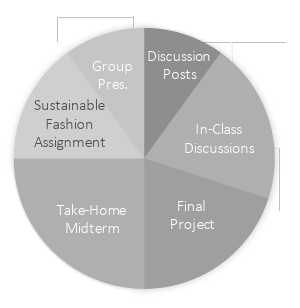
Each student shall be judged based on the extent to which the student has command of the course materials and subject matter. Some of your contribution is performed within a team and is therefore dependent on team performance.
| Deliverable | % |
| Canvas Discussion Posts | 10% |
| In-Class Discussions | 20% |
| Group Presentation* | 10% |
| Sustainable Fashion Assignment | 15% |
| Take Home Midterm Exam | 25% |
| Final Project* | 20% |
| 100% |
(*) indicates team/collaborative projects. All deliverables that do not have an asterisk (*) must be completed individually.
This is an application-based course. Much of your work and evaluation will be based on critical thinking involving marketing skills and knowledge, not memorization of concepts.
Canvas Discussion Posts (10%}
Given that a large portion of your grade (20%) comes from in-class discussions, it is necessary to read the assigned cases and articles. Therefore, to help you prepare for the in-class discussions, you are required to answer 1-2 questions each week about the assigned readings. These discussion posts are short, do not require you to respond to your classmates, and are designed to track your reading engagement. Your grade will be determined by evidence of preparedness.
Discussion posts are due Tuesday at 11:59 pm before each Wednesday class.
Class Discussions (20%}
This class cannot be taken online. Marketing and the Fashion Industry are interactive fields. You are expected to be prepared for each class and to speak up! You will contribute to the classroom experience through the 3 Ps: be present, prepared, and provide input/valuable additions to our discussion. Feel free to bring in examples of current events and situations to enhance our understanding and excitement for the topic. Cold calling is used to make sure everyone is heard.
Participation is quite important to the class and your grade. Attendance is taken in every class. Regardless of the reason for your absence, you will be downgraded for every absence. There is no need to alert me to your absence for this reason.
Your participation grade is NOT an attendance score. You can attend every single class and still receive a C if you do not participate or add value. Grading is dependent on the level of value you contribute to each and every class. A's go only to students who go above and beyond. After every class, I rate your participation. It is "0" if you do not show up or are more than 20 minutes absent. It is "1" for attending but passive learning. It is "2" for attending and contributing to the class (speaking up). It is "3" for contributing in a meaningful way to the day's discussion. So that you know where you stand on this grade in the class, I do provide a grade (out of 7.5) around the middle of the term. You are also welcome to check in with me at any time.
Computers will be closed and cellphones away/off during class. The presence of these devices is not only distracting, but also lowers cognitive functioning1 and limits processing of information.2
(1) Ward, A. F., Duke, K., Gneezy, A., & Bos, M. W. (2017). Brain Drain: The Mere Presence of One's Own Smartphone Reduces Available Cognitive Capacity. Journal of the Association for Consumer Research, 2(2), 140-154.
(2) Mueller, P. A., & Oppenheimer, D. M. (2014). The pen is mightier than the keyboard: Advantages of longhand over laptop note taking. Psychological Science, 25(6), 1159-1168.
Group Presentation (10%}
In this engaging and interactive group project, you will utilize your creativity, analytical skills, and marketing knowledge to propose a groundbreaking fashion collaboration between two popular and distinct brands. This assignment aims to blend theoretical knowledge with practical application, aligning with the core objectives of the Costello College of Business.
You will begin by conducting a comprehensive analysis of each brand's market positioning, target audience, and unique selling propositions. You will identify and articulate the synergies that make these two brands suitable partners. Your proposal should clearly define the goals of the collaboration for each brand and consider how the collaboration aligns with each brand's values and objectives.
Each group will deliver an 8 to 10-minute presentation, followed by a Q&A session. The presentation should be visually engaging, utilizing slides or other multimedia elements to support the narrative. Presentations will be evaluated based on creativity, analytical depth, demonstration of marketing knowledge, and presentation skills. More details to come via Canvas and in-class.
Sustainable Fashion Assignment (15%}
Fashion production significantly impacts the environment, contributing to 10% of the world's carbon emissions and resulting in a vast amount of textile waste and microplastic pollution (UNECE 2018; Ellen MacArthur Foundation 2017). In light of these challenges, this individual written assignment focuses on the sustainability efforts within the fashion industry. Your task is to critically analyze a specific fashion company's sustainability initiatives, evaluate their effectiveness, and propose strategic marketing recommendations for enhanced impact.
The purpose of this project is to develop a comprehensive understanding of how a chosen fashion company is addressing sustainability in its operations and marketing strategies. You will assess the successes and pitfalls of their current practices and suggest improvements or new strategies, particularly in the realms of product, place, price, or promotion.
Deliverables:
- A 1000-word (or less) report, double-spaced, 12-point Times New Roman font.
- The report should include:
- An introduction to the chosen company and its current sustainability efforts.
- A critical analysis of the effectiveness of these efforts, including any available data or case studies.
- Strategic marketing recommendations to the brand for enhancing its sustainability impact. These recommendations should be specific and feasible, considering the company's current market position and resources.
- You should utilize academic journals, industry reports, company publications, and credible online resources. If there is little or no information online about your brand, you may find it useful to examine and refer to what their competitors are doing. Proper citation of all sources in APA format is mandatory.
Evaluation:
- Depth and relevance of research: quality and pertinence of information gathered about the company's sustainability efforts.
- Critical analysis: Ability to critically evaluate the effectiveness of the company's current practices and identify areas for improvement.
- Creativity and feasibility of recommendations: Innovativeness and practicality of the proposed marketing strategies.
- Clarity and structure of the report: Coherence, organization, and presentation of the ideas.
- Adherence to assignment guidelines
Take-Home Midterm (25%}
The fashion industry, with its global reach and influence, presents a multitude of challenges and opportunities for marketing professionals. This take-home midterm essay assignment is designed to assess your understanding and application of marketing principles within the context of the fashion industry. Your task is to write a research-based analytical paper, critically examining a pertinent topic within the fashion industry, utilizing your knowledge of marketing theories, strategies, and practices.
You will select a topic from a list of provided topics, conduct thorough research, and present a well- structured analysis and argument. The deliverable is a 1500-word analytical essay, double-spaced, in 12- point Times New Roman font. This essay constitutes a significant portion of your grade, reflecting the depth of understanding and analytical skills expected at this level. More details will be provided two weeks before the due date (i.e., two weeks before March 20th).
Final Project (20%}
In the dynamic world of fashion, creating an effective marketing plan for a new product or line is crucial for success. This final group project is an opportunity for you to apply the comprehensive marketing knowledge acquired in this course and your previous marketing courses. Working in groups, you will develop a detailed marketing plan for a fashion product or line, which you will present in class in a 15- minute presentation. The plan should be innovative, evidence-based, and well-articulated, reflecting a deep understanding of marketing strategies in the fashion industry. Groups will consist of 4-6 group members, depending on the final class roster. Your grade will be a collective group grade.
Deliverables:
- A 15-minute in-class presentation of your marketing plan on April 24th
- Submission of your presentation slide deck, which should include the following:
- Situation Analysis: Provide an overview of the brand, the product/line, and clear, evidence-based objectives for your marketing plan, aligning them with the overall business goals.
- Target Market: Define and justify your chosen target market, detailing demographics, psychographics, lifestyle, and behavioral attributes.
- Positioning Statement: Present a concise positioning statement that encapsulates the essence of your marketing strategy.
- Communications Plan: Detail your proposed marketing communications mix, with an emphasis on creativity and specificity. Include mock-ups or storyboards for proposed advertisements or social media content.
- Media Mix and Measurement: Explain the allocation of your media mix and how you will measure the effectiveness of each component.
Evaluation:
Your presentation and slide deck will be assessed based on:
- Comprehensive and insightful situation analysis, including logical and evidence-based marketing objectives.
- Clear definition and justification of the target market.
- Creativity and clarity in the positioning statement and communications plan.
- Specificity and feasibility in media mix and measurement strategies.
- Overall presentation quality, including organization, visual aids, and team coordination.
- Peer evaluations. Peer evaluations will be conducted to ensure equitable contribution from all group members. Significant discrepancies in contribution may result in individual grade adjustments.
Other Grade Considerations
I do not change grades on request and I do not round up grades. For example, if you get an 89%, I will not round it to a 90% so that you can get an A.
All late submissions (including discussion posts) receive a 10% deduction per day, starting immediately after the due date. There are no exceptions.
Below is a table outlining how letter grades are determined.
| Grading System | |||
|---|---|---|---|
| Standard Grades | Grade Points | Numeric Grades | |
| A | Superior/Excellent | 4.0 | 93-99 |
| A- | 3.7 | 90-92 | |
| B+ | 3.3 | 86-89 | |
| B | Good/Better than Average | 3.0 | 83-85 |
| B- | 2.7 | 80-82 | |
| C+ | 2.3 | 76-79 | |
| C | Competent/Average | 2.0 | 73-75 |
| C- | 1.7 | 70-72 | |
| D+ | 1.3 | 66-69 | |
| D | 1.0 | 63-65 | |
| D- | Minimum Passing | 0.7 | 60-62 |
| F | 0.0 | 50-59 | |
Course Calendar
| Week | Date | Topic | Readings | Due |
|---|---|---|---|---|
| 1 | 01/17 | Introduction to Fashion Marketing | ||
| 2 | 01/24 | Consumer Behavior in the Fashion Industry |
HBSP Case Study: TedEx video: BoF Online Article: |
Discussion Post (Due Tuesday before class @ 11:59pm) |
| 3 | 01/31 | Sustainable Fashion & Fast Fashion |
HBSP Case Study: Online articles: |
Discussion Post (Due Tuesday before class @ 11:59pm) |
| 4 | 02/07 | Luxury Branding & Counterfeits |
HBSP Case Study: Online article: |
Discussion Post (Due Tuesday before class @ 11:59pm) |
| 5 | 02/14 | Creative Directors, Creativity, Branding, Traditional Media & PR & Group Work |
Podcast: BoF Case Study: BoF Article: |
Sustainable Fashion Assignment Due Discussion Post (Due Tuesday before class @ 11:59pm) |
| 6 | 02/21 | Digital and Influencer Marketing in the Fashion Industry & Group Work |
HBSP Case Study: BoF Article: |
Discussion Post (Due Tuesday before class @ 11:59pm) |
| 7 | 02/28 | Group Presentations | Group Presentations | |
| 8 | 03/06 | Spring Break | ||
| 9 | 03/13 | Emerging Trends and Technologies in Fashion Marketing | HBSP Case Study: Prada: Haute Couture in the Digital Era |
Discussion Post (Due Tuesday before class @ 11:59pm) |
| 10 | 03/20 | Take-Home Midterm Exam | Take Home Midterm Exam | |
| 11 | 03/27 | Retailing & Merchandising | HBSP Case Study: Amazon in Fashion |
Discussion Post (Due Tuesday before class @ 11:59pm) |
| 12 | 04/03 | Menswear & Sports Marketing |
BoF Case Study: BoF Article: |
Discussion Post (Due Tuesday before class @ 11:59pm) |
| 13 | 04/10 | International Marketing & Group Work | HBSP Case Study: Dolce & Gabbana: Racism, Stereotypes, or Being Funny? |
Discussion Post (Due Tuesday before class @ 11:59pm) |
| 14 | 04/17 | Global Expansion & Group Work | HBSP Case Study: Lululemon Athletica: Driving Global Growth |
Discussion Post (Due Tuesday before class @ 11:59pm) |
| 15 | 04/24 | Final Presentations | Final Presentations |
Student Responsibilities
Participation
You are responsible for reading all assigned materials, listening and taking notes of weekly lectures, submitting all assignments by the due date, logging into your course at least once a week, and actively participating in class-wide and group discussions. If there is a definition, concept, or principle you do not understand, it is your responsibility to ask for clarification. Please schedule an appointment.
Late Work, Extensions, and Missed Exams
I do not offer extensions or changes to the due dates except for medical reasons that have a doctor's written notice. If any exceptions are to be considered, they require evidence in the form of a doctor's note or other tangible proof.
If you do not contact me via email before the missed deadline, I will not consider your request for an extension or a reschedule. To be clear, if an exam is at 10:30 am and you email me stating that you cannot come to the exam at 10:30:01 am, I will not consider your request to reschedule the exam because the deadline has passed. To avoid any problems, please contact me immediately at the time of learning of your inability to complete an assignment or test via email; the earlier, the better.
Late work will receive a penalty of 10% per day. Any requests to waive this penalty made after the deadline of the assignment will be denied.
Names and Pronunciation
If you wish, please share your name and gender pronouns with me and how best to address you in class and via email.
Teams
Several assignments will be conducted through team efforts. These assignments include eight in-class assignments and a marketing plan presentation. Team work is always a challenge. On one hand there are free riders and alternatively, there are domineering people who refuse to listen to the thoughts of others. Each member has the responsibility to make the team work. As an incentive to assure team cooperation, each member will privately evaluate all members of the team at the end of the semester.
Late Work
Assignments delivered late will be penalized 10% for each class day missed.
Use of E-Mail
George Mason Email must be used at all times for correspondence with the instructor. No exceptions. Students should clearly identify themselves and their course number and section in any Email correspondence.
Students must use their George Mason email account to receive important University information, including communications related to this class. I will not respond to messages sent from or send messages to a non-Mason email address.
To print: Right-click and choose “Print,” then follow your browser’s print settings.
To download: Right-click and choose “Print,” then select “Save as PDF.”