

MGMT 463: Negotiations in Organizations Master Syllabus
Course Instructor:
Office Number:
Office Hours:
Email:
Course Meeting Times:
Course Website: Canvas
Course Description
Negotiation is a means of meeting your interests (e.g., getting what you want) when doing so depends on others. Negotiation is effective when you get more or lose less than you would have if you did not negotiate, and getting more of what you want is always the objective when negotiating. Any situation which involves multiple parties, apparent conflict, and interdependence has negotiation potential.
Course Materials
(Required) Rockmann, K., Langfred, C., & Cronin, M. (2020). Negotiation: Moving from conflict to agreement. Sage Publications. (ISBN: 978-1544320441) Other readings may be assigned throughout the semester and posted on Canvas.
Course Objectives
This course will teach you how to be a better negotiator by:
- Learning to identify opportunities for negotiation
- Understanding how to analyze a situation for negotiation potential
- Understanding how to plan for behavior during the negotiation
Concentration Learning Goals
Your ability to meet course objectives will depend greatly on some more general skills which we will also practice, specifically:
- Knowing how to analyze
- Knowing how to think efficiently
- Knowing how to think critically
- Knowing how to adapt and deal with ambiguity
BS Business Learning Goals
By the end of the BS Business program, students will master:
- The social, global, ethical, and legal contexts of business and will be able to reflect on the role of the individual in business. *
- The ability to apply knowledge of professional skills necessary for success in business including effective business writing. *
- Technical and analytic skills appropriate for success in business.
- The ability to apply knowledge of core business disciplines including accounting, finance, information systems, management, marketing, and operations management.
- How research in the business disciplines contributes to knowledge and how such research is conducted.
*Program and concentration learning goals that are addressed in this course
Notes: * all page numbers refer to pages in the text unless otherwise specified
**We will make this up later in the semester with small group meetings scheduled outside class time
Students Responsibilities and Policies
What I expect of YOU
- Before class
- Read the assigned readings, familiarize yourself with the assigned cases, bring the cases (in some form) to class
- Put in your ASK assignment using the link on canvas
- During class –
- BE ON TIME
- Electronics are only to be used for/during negotiations (looking up stuff, calculations)
What you should expect of ME
- I am direct, and I tend to seem more critical than warm. You’ll get used to it (or you won’t).
- More than anything I want you to develop in whatever way helps you become a better person (however you define that).
- The more engaged you are in the class, the more positively inclined toward you I will be.
- I am old school, so I want your full attention. So:
- If we are in class - keep your laptop closed, your phone in your pocket, your eyes off your smartwatch and do not text.
- If we are online – keep your screen on and your attention on whomever is speaking. Use the chat function to add to discussion
Other Policies of Note
- Help each other all you want. When I evaluate you, I am evaluating you so be sure you can demonstrate effort, competence, and creativity (see below). Whether you achieve this from solitary reading, a study group, or some other means is immaterial.
- The only thing I grade is class participation, case execution, and the final exam (described below)
- You are free to miss class, but if I call on you and you are not there it will negatively impact your class participation score
- Exams are not to be missed without prior written approval from Dr. Cronin
- There are no makeups on classes or cases. A makeup exam can be taken provided the missed exam is excused.
- The only thing I grade is class participation, case execution, and the final exam (described below)
Grading Standards
In general, I am looking for three things
- Effort – Did you do the assignments? Did you put heart into the assignments? Did you try to push yourself? Did you try to contribute in a positive way to the classroom experience? Note that I cannot grade the effort you say you put in. I can only grade what I see. 2) Competence – Competence is not how good a negotiator you are, but how well you demonstrate that you learned what I taught you. People come in with varying levels of innate talent at negotiation, I do not grade you on that. I grade you on your demonstration that you understood what I taught. 3) Creativity – This is the wildcard. There are always better ways to think about negotiation, and the best negotiators are flexible and adaptive. There is no formula for how to be creative, but when you are, the results are better than what we might imagine. I will talk in a second about how I evaluate effort/competence/creativity with these devices, but first let me differentiate grades from feedback.
- Competence – Competence is not how good a negotiator you are, but how well you demonstrate that you learned what I taught you. People come in with varying levels of innate talent at negotiation, I do not grade you on that. I grade you on your demonstration that you understood what I taught.
- Creativity – This is the wildcard. There are always better ways to think about negotiation, and the best negotiators are flexible and adaptive. There is no formula for how to be creative, but when you are, the results are better than what we might imagine.
I will talk in a second about how I evaluate effort/competence/creativity with these devices, but first let me differentiate grades from feedback.
Grades measure your general performance against class expectation. Feedback tells you specifically about what you are and are not doing, as well as its effectiveness, with respect to negotiation. Do not confuse the two. The latter is what matters to me and is what should matter to you. To say “you got an A” tells you that you did well, but you will have no idea why. To say “your tactics did not convince the other side” tells you exactly what you are doing, and whether they were effective in the way you wanted them to be. It also tells you how you can improve regardless of whether that was A, B, or C grade level. In fact, if you got an “A” you may mistakenly think that there is no room for improvement. I can assure you that there always is.
It is why I give very few grades. It is why I don’t have some detailed point chart. And it is why you need to pay attention in class. You will learn as much from watching others as you will in doing it yourself.
Most students are bothered by my lack of “here is how you earn each point.” This is intentional, and it is to your benefit. We live in an increasingly complex and ambiguous world. It requires more than the capacity to execute. It requires that you figure out WHAT needs to be executed. In not telling you exactly what to do and instead having you figure it out, you learn this skill of adaptability.
The Importance of Failure
You should be prepared to make a lot of mistakes and often be wrong as you are answering questions in class. This is expected and it is okay to be wrong. People can be timid about suggesting answers that will be criticized, especially in public. But criticism is part of learning. You cannot learn if you do not push yourself to the point of failure. And you will learn faster if you are not wounded by criticism. From your mistakes you learn to adapt and fix your weaknesses. Alternately, if you give me an answer and I say “Yes, that is correct.” What have you learned? What has anyone listening learned? I will give everyone public feedback because if one person is making a mistake, I am 100% certain others are as well.
The Importance of Failure in the Cycle of Learning
Many people mistakenly think education is this:
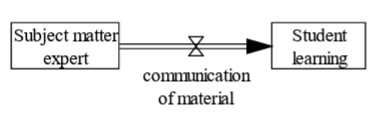
Some smart person tells what they know to you, and if they communicate it well, you learn. That is wrong. Hearing how to do something is a far cry from being able to replicate it. Typically, what you learn from hearing another talk is a very shallow sort of learning. To be able to actually achieve deeper learning (and eventually mastery) requires practice with feedback. This is represented below:

Using what you learn shallowly, you try to apply it, and you make mistakes. From your failure you can learn what is wrong, correct the errors, and then start to achieve real skill. More importantly, when an expert (me) sees where you fail, they can more quickly identify and correct the problem (this is what the blue line from SME to error correction means). Even better, as you develop more deep learning on a subject, it allows you to identify and fix your own errors more quickly (the blue line from deep learning to error correction). This is a virtuous cycle, but it *requires* failure. You cannot improve if you do not push yourself to the point of failure. And you will learn faster if you are not wounded by criticism because then I can be direct about what is wrong.
Evaluation
Class participation – This relates to your behavior any time class is in session and we are not on break. It is especially important when we have guests. Effort means engagement with what is happening. Competence means how well you can discuss and apply the material you have learned to the conversations.
Case Execution – This relates to how well you negotiate the cases. To negotiate well means to be prepared (effort), and to apply the lessons of the class to that case (competence).
Final – I will give you a final case to analyze – it will be very much the culmination of what we have done all semester with all the cases you read for each class. It is a short answer test given in class focusing mostly on competence with the material.
- Ask assignment (part of your “final”) –
EACH WEEK you will ask for something you typically would have accepted “as is” or at full price. You might ask for a family member to do something for you, for a discount, for something extra, anything that you would not have asked for normally. There is a link on blackboard in the assessments section for you to use to tell me:- What you asked for (it can be vague)
- The outcome you received.
- An estimate of the dollar value (IN NUMBERS!!!!)
Grading Rubric
| Item | Inadequate | Adequate | Proficient | Excellent |
|---|---|---|---|---|
| Class Participation | Late, distracted, frequently absent, disruptive, looks at technology for non-class related reasons | Attentive to people in class who are speaking, attempts to answer questions at least twice each class, | Adds value to what others have said in class, answers questions demonstrating command of the taught material | Provides insight on other’s answers as well as to the questions posed |
| Case Execution | Did not read the case, does not have the case or notes on it, tries to pretend they are prepared | Comes to class with cases and notes; makes an honest attempt to play their assigned role | Demonstrates use of course concepts when negotiating; does not merely rely on their personality | Demonstrates skill in negotiating the case; claims significant value using the lessons of the course |
| Final | Little or no evidence that class material has been absorbed; missing more than half of the ask assignments | Effortful, if somewhat misguided, answers to questions; no more than 25% of ask weeks missing | Correct answers to questions; no more than 10% of ask weeks missing | Insightful answers to questions; no more than one ask week missing |
Grades are given thusly
A: Excellent on all three items
B+: Excellent on two, proficient on 1 item
B: Proficient on all items OR one Adequate, one Proficient, and one Excellent item
C+: Proficient on two items and adequate on one OR Excellent on one item and adequate on two others
C: Adequate on two items and proficient on one other OR inadequate on one item but proficient/excellent on another
D: Inadequate on two items (regardless of the third)
F: Inadequate on three items
To print: Right-click and choose “Print,” then follow your browser’s print settings.
To download: Right-click and choose “Print,” then select “Save as PDF.”